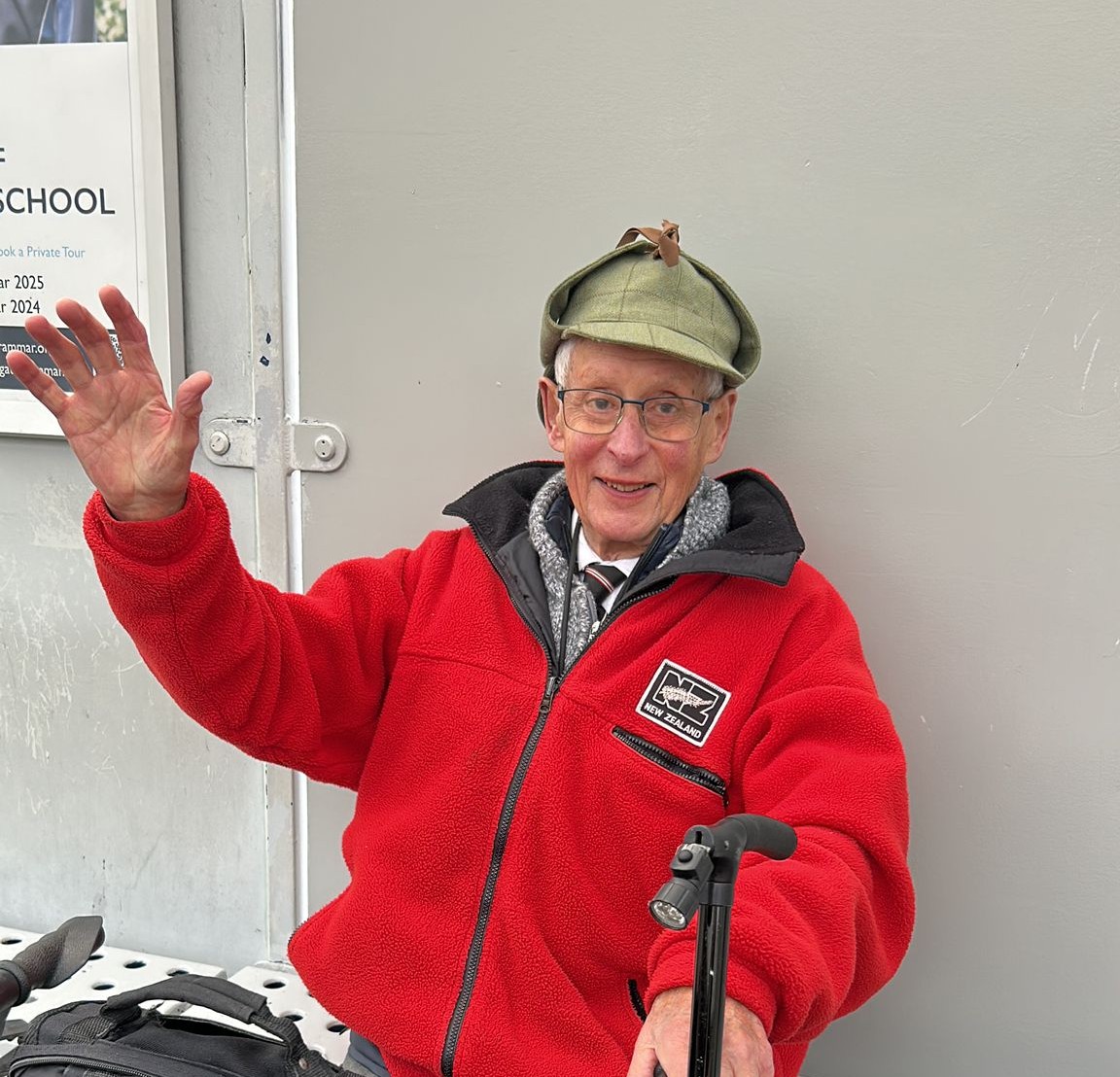
“I’m ready to die now”.
His swollen hands, balloon-like, inflated by illness or medication, sat gently in his lap atop the white bedsheets. His single-use gown’s pattern of plaid paid incidental homage to the chequered shirts of his life. An image of stillness, punctured by Gramps’ mind bursting forth through the opiate cloud.
His words arrived without compunction, almost non-plussed, underscored by a quiet obliging duty. Like a weathered town crier, atop a soap box in a well-trodden muddy square, announcing, to a frenzied crowd, the imminent arrival of a duke. Gramps had spent the past week surging from fevered dream to cooled awakening, upon this hospital bed in East Surrey Hospital. In his words, as reported with a startling vivacity, he was “between worlds”.
And now, he felt, he was ready to die.
My youngest brother and I sat beside him, resting our forearms on the chair’s petrol-blue polyvinyl-laminate-coated padded arms. A clarified smell of hospital hung distantly in the room. The room’s undulating wordlessness articulated the sound that moved through it. A strained beeping, a gentle wheezing, and the ruffle of other bedded peoples, obscured by curtains, continually readjusting themselves. Death’s presence lay weighty. Silent, but here: a heaviness that seemingly squeezed white noise from the bright bleached surfaces.
Alike a jet engine, the space’s energy flowed through me, in great rushing waves, before being contracted by my throat, then squeezed out in material form through my tear ducts. This was not sadness or fear: it was a reckoning with magnitude. The inviolable immensity of death met, by a mortal, with courage, dignity and equanimity. Death, made minuscule, by the tiny man who lay before us.
Looking right at both Charlie and me, he affirmed what we already knew to be true. “This is the last time you’ll see me”. Delivered flatly but tie-dyed in quiet wonder. Countless halcyon years spent ship-wrecked on this desert island, and now a ship appears on the horizon. How curious, his tone said silently, to have spent so long in this strange and perfect dream. Decades spent walking home and now, he finally sees the flicker of the hearth. Quietly, as if looking toward the timetable on a train platform, he turned his face back toward the ceiling.
Tears wound down the faces of us boys, in oxbows and rivulets, before they formed tributaries into the great ocean of love. We felt compelled to speak. Steadying the bows of our trembling lips, we found the strength to prise and keep them open. And from these crevices, an outpouring of love, admiration and gratitude poured, for every duty honoured and each relationship nurtured.
Wiping my cheeks, with my sleeve-clad triceps, then pushing myself off the armrests beneath me, I leant across Gramps, holding his hand then kissing his forehead, with the softness of a butterfly landing atop the breeze.
“Thank you, Sam”, he uttered, his voice inflected with surprise and underscored by a quiet agreement: ‘yes, that is just what needed to be done’. Once again seated, Charlie then rose, too placing his lips on the place that had held all of Gramps, and being met with a warm murmuring gratitude.
All again seated, and with Gramps’ eyes closed, we let the space hold us for a good while longer. After enough time had passed, I squeezed Charlie’s knee and nodded to which he nodded too. Our minds’ arms flailing wildly, like Ganesh plugging a burst pipe, we wrestled with the pouring onslaught within, both wanting to honour our grandfather with the same strength he held.
With death’s hand resting upon his right palm, he offered his grandsons a shake from his left one.
His voice soaked in a softly courageous humility, he spoke. “All the best”. As understated as it was gravitational. Three monosyllabic words that held all that could possibly be said.
All the best.
A summary, a farewell, and a wish.
Stunned, we stumbled those words back to him. Then, rising slowly, with our shoulders pulled back, we brothers walked out of the room. With the door closed behind us, and material contact with Gramps closed with it, we fully and finally acknowledged the great weight of being, doubling over in deep exulting gasps.
Our aunt, who, alongside our Dad, as well as our uncle, had been waiting outside, held me as I held her, and there we wept some more.
My memory blurs from then before the focus again sharpens, when getting into the passenger seat of Dad’s car, in which he then drove us to the train station. Drained and stupefied, words refused to arrive, but silence, equally, failed to call. A purgatory of sound. Inadequate a place, I reached for the magic lamp of Spotify, touching my phone’s screen and wishing intently for music that could express all this feeling.
Something deceptively random (see: algorithm, intuition, chance, habit) chose a song.
Enter percussion as softness, melody as inevitability, and riff as reminder. Then, when ready, arrives Adrianne Lenker, the voice of Big Thief. She sounds like gently crinkled iridescent tissue paper. The depth of her humanness – the crisply smoked enunciation of each syllable; every crystalline vowel that settles into a drifting murmur – made audible by the proximity of her mouth to the microphone. She is both immediate and entirely distant.
Change, like the wind
Like the water, like skin
Change, like the sky
Like the leaves, like a butterfly
Would you live forever, never die
While everything around passes?
Would you smile forever, never cry
While everything you know passes?
Death, like a door
To a place we’ve never been before
Death, like space
The deep sea, a suitcase
Would you stare forever at the sun
Never watch the moon rising?
Would you walk forever in the light
To never learn the secret of the quiet night?
Gramps died a few days later. He lost his speech, then his capacity to interface with the outside world, then the quiet metronome of his heart, before, finally, losing himself. To his last breath, he lived the philosophy he had spent a lifetime embodying.
Until the final months, well into his ninety-first year, he delivered sermons, entirely of his own composition, as a lay reader at St Mark’s church. Dressed in his cassock, he’d mount his mobility scooter and make soaring expeditions across all of town – and often beyond – bringing communion to the “old people”, who were otherwise incapable of attending church. He gave, generously. His money, to countless charities. But, more essentially, his time and presence, to all those who needed it. To the Samaritans, to the Sea Cadets, to his family and his neighbours and the world of people whose lives his touched.
From deep within, too, emanated a latent valence of spirituality. A felt sense that there is something more to this than merely this. He believed in the love of Jesus – and he practiced that love, as both the question and the answer. In the years since his beloved wife, Jenny – Granny – passed away, after nearly 60 years of marriage, he would on occasion talk as to how he would someday see her again.
But, for Gramps, faith was not something to teach. It could not be reduced into mere religion nor defined by derisory dogma. Faith was not superiority. And he resided, until his last breath, within the bounds of a quiet epistemic humility. As open-minded as he was open-hearted; as contemplative as he was certain. Scripture was not divine command so much as a series of tales and fables, some containing fundamental revelation and truth, with others, too, amounting to little more than tosh.
Sometimes, throughout his life, I would ask him if he feared death. In response, he never gave me Leviticus, instead, looking at me – straight-faced – while opening his eyes a little wider. He’d then unconsciously wobble his head, with his jowly cheeks then jostling with his jaw, combining into an oxymoronic picture of serious-unseriousness.
He would then speak, offering verbatim the following observation: “Well, if there is a heaven, then that’s jolly good… And if there’s not, well I won’t be there to mind!” A hearty laugh would follow, as he popped toward you like a jack-in-a-box, ever-surprised and delighted by the simple elegance of his anti-Pascalian observation.
Ever since the day we said goodbye, Big Thief’s “Change” has inextricably brought me to Gramps. But I feel him woven more intrinsically into the song’s fabric than mere coincidental memorial association. I feel the essence of him in the words and the images.
Of how he saw this life as a gloried gift of moment in the light, as he watched in wonder the way it dapples across places and faces; of how he moved through this great oceanic space, suitcase always in hand; of how he saw death, as merely yet another door, another portal of mystery, to be approached with reverence, acceptance, curiosity and courage.
Where there is Gramps, though, there is Granny, and in the opening lines it is her presence I feel.
Granny as breath, gently blown across the torn skin of a grazed knee. Granny as sky, soaringly soft, wide, and ever-changing. Granny as a leaf atop a poplar tree, illuminated by the sun shining through, rustled by the wind dancing through. I see Granny’s smile, that sometimes tipped so quickly into tears of fear, only for her then to find herself dropped spontaneously back again into laughter.
In the lyrics on from there, though, it is Gramps and all he was.
Gramps as child, aboard a boat, traversing the world to New Zealand, as an evacuee from Blitz-era Britain. I imagine him, even then, calm and brave and kind, peering quietly curiously out across the waters’ immense expanse. Him then again, almost ninety years later, retreading that journey in a looped circle of tradition, honour, and humility. Born again, a hundred times over – through doors and more doors – but still always that same child, peering on out. His essence as blueness: of water, of the deep sea, of navy and royalty.
Gramps as man, who basked so contentedly in the brightness of day, but, too, one who intimately knew the quiet secrets of nighttime. Every night, he knelt in prayer beside his great antique teak bed. Hand-carved and well-seasoned, raised high as if to obscure a pea within, it was the place he had slept for much of his life, first as a newborn with his parents, then in the arms of Granny, before cradling between them their own bawling bairns, and then, finally, alone. With a candle burning softly, he met with his loved ones in loving contemplation – naming them each, both living and since passed – as he became the space in which past and future folded into present.
Gramps laughed a lot. But I’m sure, too, that he cried.
Tears for all that had passed, that is passing, and that will come to pass. Tears for himself, for the boy he was, for the man he became, and for the person he himself would ultimately have to say goodbye to. Tears that he would have to say goodbye to all those who survived him. And tears for the knowledge that we will each someday say goodbye to ourselves.
Gramps knew that to live forever was never the answer: so full was his participation in this life, that he knew that its condition was change. To love and be loved. To give and be gifted to. To say goodbye to everything that passes while knowing, always, that he never sat outside of the world. Gramps knew that to live fully was to give – and that someday, he would give himself to stepping through that ultimate door. And, when the moment came, he did so in the manner with which he lived his life.
Change, like the sky
Like the leaves, like a butterfly
Death, like a door
To a place we’ve never been before
As I see it now, Gramps did not merely believe in Christianity. Instead, he lived it. He became it. A lifetime spent, with whittling knife in hand, delicately shaving away the confutations of self, freeing from these bounds the true form of selfless, compassionate love.
The living word, embodied in a man.

Leave a Reply