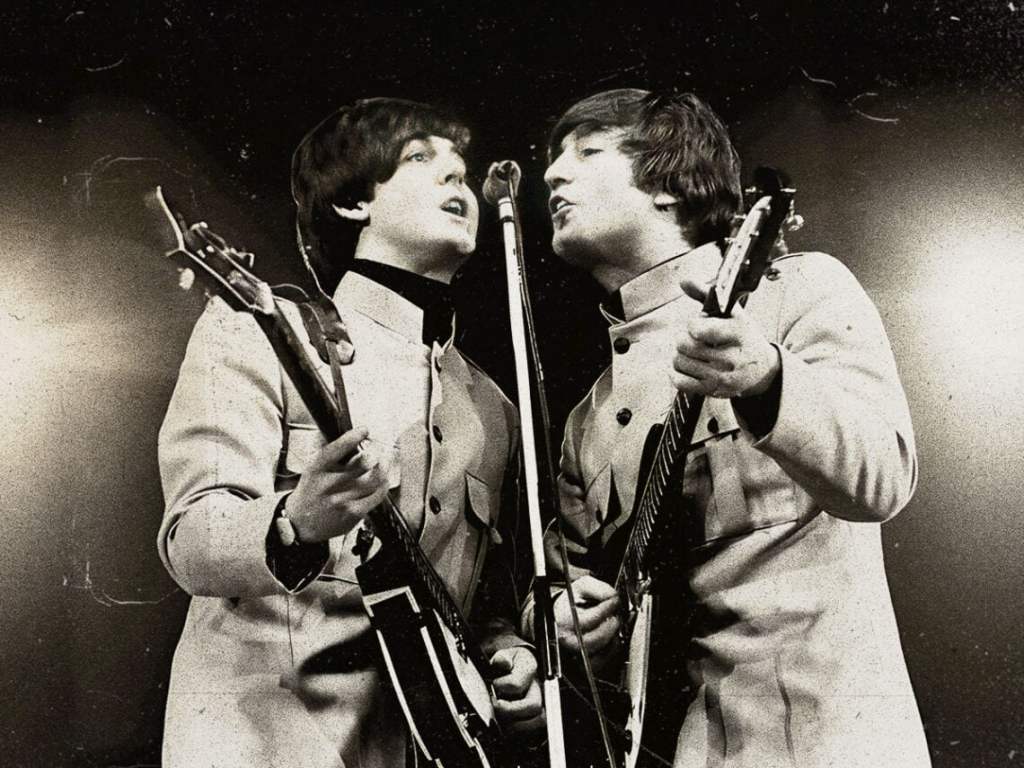
A good friend would not stand up and walk out on a friend. Even if they were singing out of tune.
A good friend helps you get by – when your love is away, or when you’re alone at the end of the day.
On its face, Lennon-McCartney’s song is one of friendship. But it’s not really. It is a song about romantic love, and what one ought do in its absence.
Friends, through Sergeant Pepper’s lens, are not an end in themselves. They are a substitute, an alternative, a gap-filler. Love saves all, but when love is away, we must instead try to get by, and friends offer a filling of this void.
Friends, to The Beatles, are not fickle. Friends provide connection, and solidarity, and honesty, and company.
In the cold depths of loneliness and lovelessness, friends will help you get high, and in doing so create some simulacrum of the warmth and soaring peaks that romantic love gives so readily.
I find truth in this, and a benevolent honesty too. But I can’t help but feel there’s something missing from such a conceptualisation, which raises the question, ‘What really is a friendship?’
People use the term loosely, but friendship, to me, is something far more substantial than mere company for solace’s sake.
I imagine friendships to be like trains on rails.
We are each, as this analogy goes, a train, each speeding forth along our own tracks. Zipping along, sometimes feeling like islands and solo traversers, until the moment we hear a murmur. A shifting in the sands, a sonorous wobble in the air.
A sound that signifies another train, hurtling along its own gleaming tracks of subjective experience, at the same pace, on parallel tracks.
Metaphorically maybe many thousands of miles apart – flying through different landscapes of subjective experience, assembling different typologies of belief and preference – but vibrating at the same frequency nonetheless.
Hey, friend, we intuit the other.
Some kind of cosmic surf, on which we find ourselves riding the same wave. There isn’t a confrontation but a sharing, and a delight in that sharing.
Such is what friendship, of the truest kind, feels to me. A meeting of minds; a singing from the same song sheet of fraternity and sorority.
Friendships – these trains-turned-tuning-forks – are the fertile fields in which growth, development, understanding, fun, delight and learning bloom most beautifully.
Friendship is a reassuring belly-rub of solidarity, momentarily laying waste to the sensation that you’re alone in this interstellar morass of infinitude and emptiness.
It, too, is a recognition that I like who you are and I like the project that is your life. It’s not necessarily my project, but I’m glad you’re loving it. It is an I want to hear how you think, I want to learn how you see the world, and then maybe, it could be cool for us to see some of it together.
Friendship is not grounded in any shared belief, but instead in a shared language of experience. And it is a language through which we can explore past the bounds of where the individual previously ended.
…
So how, then, is friendship different from other forms of relationship?
Rather than demarcating friendships from other relationships, I instead see them as the foundational base. My mum, dad, brothers are friends. And in romantic relationships, I have always felt each girlfriend to be, first and most foundationally, a friend.
Friendships are not lesser nor demarcated; instead, friendship is the productive base upon which all meaningful relationships are built. We can call such friendships friendship simple.
In the above-listed friendship complex there is more that can be built upon this foundation. Phenomena of seemingly greater depth, meaning, and profundity than can be found in friendship.
Intimacy, inextricable intertwining, trust, and the promise of the seemingly immutable. And attendant to each of these, a much greater set of implicit and explicit duties.
Friends cannot meaningfully approach these spaces without the friendship becoming something else. To slip this barrier is a transition, a shift in relation to something different and more complicated.
In marriage, it is often said that you must make anew your vows each and every day. Marriage as an emergent phenomenon of two distinct consciousnesses, each subject to continual change.
When the angle of your tracks starts to shift from their previously perfectly calibrated orientation, work must be done to realign. When one’s speed slows whilst the other accelerates, the maintenance of the union is contingent on adjusting the quantity of coal flung into your engines.
Not conditional on blood, nor the drifting requirements of sex and physical intimacy, friendship simple is less binding. This makes the work required to sustain such relations less demanding, but perhaps even more essential.
I’m terrible at texting, and I am not, to anyone, a daily friend. But when it matters, I try to be all in.
Real friendship is alive and it is breathing. And like all complex living things, its flourishing and survival depends on input, integration, and attention.
When with friends (both of the simple and complex kinds) – on the phone or in-person – I endeavour to give them all the love and attention I have at hand.
Reassure, empathise, connect, recalibrate, and delight.
This is not synonymous with being happy and positive, irrespective of my inner state. Instead, it is a promise to be authentic, whilst also trying to meet you where you are.
When opportunities present themselves to show your friends how much they matter, reach for them, like a tubby child leaping happily, yet steadfastly, at a massive swinging piñata.
…
My past year has been one of significant change. From full-time education and the family home, into rented rooms and a (somewhat) grown-up corporate job.
And throughout this change, many of my friendships have changed too. A frequency that used to ring so sweet at school or university now jars awkwardly.
Who am I? Who are you? And why did we love this?
When meeting old friends, we must either tune in to our older frequencies – nostalgia, recounting shared experience of old – or we must, hand in hand, walk toward the new frontiers of this friendship.
I believe friendships too precious, too sacred, to be lost to a gentle wind. To work towards a friendship’s continuance is not an act of conflict; it is an act of patience, investment, and effort. Not of bending or changing each other, but for carefully feeling our way through the darkness across the contours of each other’s personality, until we find again the light of our common language.
I have a friend named Ben, of whom I am very fond. I’ve spent much of an earlier article articulating this fondness. Through our differing trajectories of travel over the past year we have kept in touch, but over the last few months, I was left with a discordant feeling.
Something that sounded ever-more like clashing cymbals than singing violins. Something more nagging than mere background cosmic radiation, and something that did not leave me with the feeling of Show me more.
A contraction, as Ben would so succinctly put it, rather than an expansion.
So we called this weekend, and we spoke, and I struggled to articulate and express. How could I express a feeling that hasn’t even formed fully?
Well, as it turns out, with a patient friend on the end of the line, who is reflective, honest, considered.
We spoke openly, exploring what felt different and discordant, before returning gradually to a place we both knew to sound good. The melody kicked in as the rattle of the orchestra’s harmony rose in the background, before ultimately breaking into a symphony of expansion and electricity.
Riding alongside each other on our parallel tracks, finding inherent joy in the synchronicity itself. And my goodness does that feel good. But friendship, of any real form, cannot be reduced to measures of pleasure, utils, or happiness.
To refract your experience through the mind of another, who can translate back their musings in your shared form of language? That is pure magic – entirely majestical – and that is what human connection is really about.
And yet, sometimes, friendships do fizzle out. Sometimes, the tracks veer so dramatically, that as you see each other careen off toward different setting suns, you deem the effort of crossing the chasm too great.
And that’s okay. This isn’t a tragedy so much as an actuality. People change, and friendships do too. We may wave goodbye from atop your locomotive and occasionally make contact across a crackling radio-wave, just to see how they are. And you never know: there may come a day when your tracks divert you back to that same melodious pitch.
The tragedy, however, lies in the loss of friendship through unintentional neglect – through valuing a friend, but not putting in the necessary work to realign your tracks.
I will never walk out when a friend is singing out of key.
But if that friend neglects this emergent property, this spark within the kindling, by not connecting on the occasions that we meet? Well, honestly, it may be a while before I next spend another Friday evening listening to them sing again, irrespective of how in-tune or out of tune they are.
…
The Beatles weren’t wrong to position friendship as the thing that sustains us through gaps and emptiness. They were simply being honest about the work that friendship actually does in our lives – a fount of meaning and solidarity, different from that of family and romantic love.
Indeed, they place friendship simple on a different pedestal than that of romantic love, but clearly so do I. Friends float in and out, providing sustenance, vitality and insight when they do.
Perhaps, then, I was too hasty in distancing myself from Lennon and McCartney’s tome on friendship.
So much of life is merely getting by, and friends make that getting by so much sweeter. Not providing daily doses of love and affection, but instead draping arms around shoulders when it is needed the most.
Not as a second-rate substitute, but instead as something different. Less intense, but uniquely expanding, informing, and entertaining.
Friendship’s greatest beauty, however, is born from the active choice to bend your trajectory back toward alignment, when your tracks naturally tilt to divergence.
It is in the shovelling of coal to move your engine faster, or the slowing down to match their pace. This continual give and take, this flex and relax, is where friendship transcends truly.
Imagine a map, of an enormous expanse of infinite plains, through which two lines weave. Curving then parallel, then apart, before finding each other again. The map reveals a tapestry woven from two separate lives, interwoven by the many threads of togetherness and drift.
Each reconnection a furthering of the thread, another pattern emerging from what should, by all rights, simply unravel.
When viewed from afar, friendship is so unlikely. Two people, each careening through their own chaos and change, somehow maintaining connection across years and distance and transformation. An impossibility, really.
And yet, here it is before us. Tangible and real. These patterns we’ve woven together, simply because we chose to keep choosing each other.
Friendship as an apparent impossibility, in two ever-morphing selves finding continued reunification.
Friendship as a defiance, a protest against solipsism and entropy.
Friendship, then, as a miracle.

 The Eye of an Archer
Leave a comment