Plastic flowers are worse than normal flowers. Why? They are unmoving, non-living, artificial simulacrums of the original; an original which is organic, imbued with life, and entirely true to itself.
Such is the difference between one’s mental projection of Nassau – a land of beaches and palm trees, of conch and grouper and rum cake, of eternal blues and sunsets that are longer still – and the projection that appeared when I first encountered it.
Like a plastic flower, Nassau is colourful, kind of vibrant, and visually pleasant from a distance. But in the same vein, at least superficially, sincerity is dominated by commercialism.
The Caribbean is obviously beautiful. It is blue, and yellow, and green, and gorgeously simple in its aesthetic. But, too, it has unquestionably been bastardised over the last two hundred years. By corporatism, capitalism, colonialism, the slave trade, greed, and Western influence.
How dare I condemn a place, speaking with such ignorant certitude, writing off a city with a pithy metaphor or two. I agree. But that is predominantly the point – and the fun – of this series.
To share my uniquely privileged whistle-stop perspectives on the many extraordinary corners of this planet that I have teleported to over the preceding four months.
So, with great generalisation and necessary ignorance, here is my unfettered perspective of Nassau.
…
The airport was nice, and the greeting was grand.
A greeting from the stifling heat, then from the chirping birds that had found their way into the terminal’s rafters, then from the steel band in the baggage collection hall. Brightly painted walls, smiling airport employees, and a pervasive chillness, found everywhere but the thermometer.
The roads across the island were well tarmacked, and traffic laws seemed well observed.
What was once perhaps a mecca of tropical wildlife, is now more like a showroom for golf courses and luxury hotels.
18-holers carpet the island like linoleum in a ‘70s kitchen. Behemoth hunks of concrete squat on their plots like trolls. Not ugly, but incongruous with the landscape, and incongruous with the cultures and environment that preceded it.
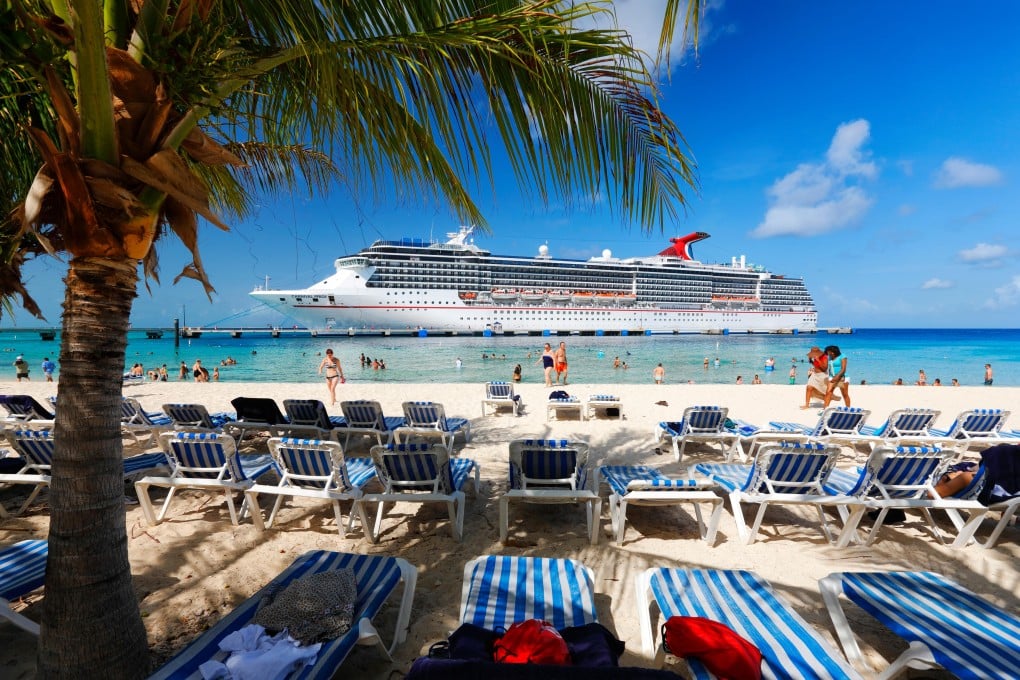
My fellow crew and I lay on loungers, basking in the beautiful sun, on an artificial beach with sand whiter than snow. Peace.
Until a cruise ship bellows, and begins swinging its massive booty within 50 metres of the shore.
Bigger still than the hotels are the cruise ships. It was, in a peace-breaking and perverse way, quite amazing watching them reverse themselves into the port. I am not sure how it is so deep, but I remember at least three or four of the world’s biggest ships nestling up to one another. Royal Caribbean, Norwegian, and Disney.
So it turns out, Disney operates cruise ships, out from Miami and across to the Bahamas. The chimneys are shaped like Mickey, and the horns play “It’s a Small World” as they dock into bay. Somehow both sweet and creepy.
Once docked, Americans spill forth. It looks like a live-animation from the final scenes of Wall-E. Many look confused, stupefied, and stop in their stumbling tracks, until the swell from behind pushes them forward.
They spill into uncountable shops selling tourist tat – pirate hats, snow globes, and t-shirts – at phenomenally inflated prices. And they buy it.
Everything on the island is expensive. I guess because it’s an island.
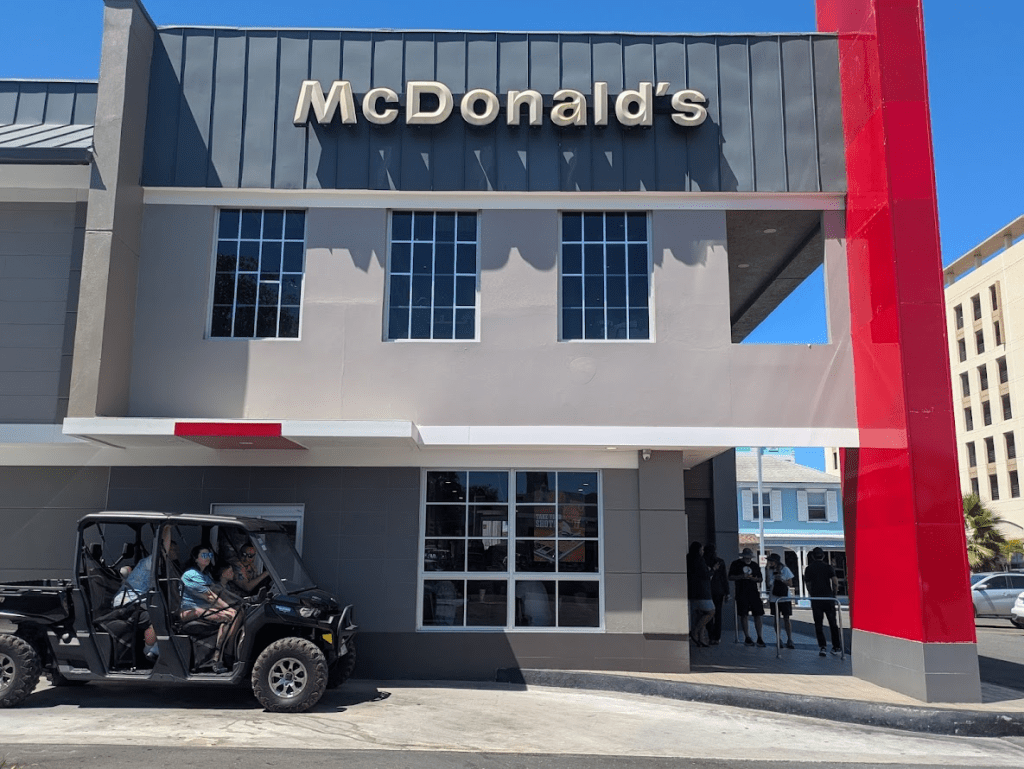
Near the hotel is a McDonalds’, and I went across the road to check it out. Americans in off-road buggies rolled around the drive through, and inside there were dozens more.
Too, there was a Bahamian man in front of me. We chatted for a good fifteen minutes. Maybe sixty, he was such a chilling guy, and kind and patient and intelligent and wise. He said the island has changed a lot in the last fifty years, but that mostly it’s good for the local economy.
On the last evening, I went for a run. I ran out away from the centre of the town, away from the hotels, and out into an area that felt more local. Bahamans smoking cigars in bars, drinking beer, and eating what smelt like the most incredible food. The vibes were cool.
I turned and ran out into a dockyard-industrial area, in which there was no one around. Scrapyards lined the dusty track, which extended out for nearly a kilometre towards the setting sun. Reaching the end I saw two scruffy looking dogs, gave them a wide berth, but nonetheless triggered them and brought twenty other dogs running out of a junkyard.
They gained on me. I don’t think I have ever been so scared in my life. I saw a rusted out trailer 30 metres ahead of me, but knew there’s no way I could get there before them. So I stopped, turned to face them, bared my teeth, bulged my eyes, and barked with as much mad ferocity as I could.
They scuttled back for a split second before regaining confidence, by which point I had restored a 10 metre head start again to reach the trailer. I leapt up it, pulling away from the jaws of the ratty snappers.
A lady in a boilersuit sauntered out of the junkyard, swatting at the dogs with a branch. “Sorry ‘bout dat”, she drawled at me with a smile. “Next time, breeng a stick.”
I ran back the way I’d come, faster than I’ve ever run, whilst laughing in ecstatic relief. I stopped at a beach on my way back, swimming as the peach sun sank through the azure sky.
…
Where real flowers bud and bloom then wilt, plastic flowers remain frozen in a state of rigid unchangingness. Part of the beauty of a natural petal lies in the knowledge that not appreciating the delicacy of the brushstrokes now, may mean one may appreciate them never.
Nassau doesn’t feel that way. It feels artificial, such that even the sunsets feel plasticky in their eternalness, just as the waters are polluted by the ships and the land is ravaged by concrete.
But too, it has the potential to surprise. Maybe the most apt analogy is like when sometimes, in an airport or a restaurant, you realise that the artificial plants are, upon closer inspection, in fact real.
There is life there; and there is real beauty too. But you have to squint pretty hard to see past the obtrusive plastic-y sheen.

 The Eye of an Archer
Leave a comment