In the landscape of cultural adaptation, few works demonstrate the metamorphosis of medium as starkly as Irvine Welsh’s Trainspotting and Danny Boyle’s cinematic interpretation.
Danny Boyle’s Trainspotting was one of the 90s’ defining works of cinema: fresh, exhilarating, narcissistic and defiant, it was as much an advert for nihilistic abuse – of drugs, violence, relationships, and self – as it was a cautionary tale.
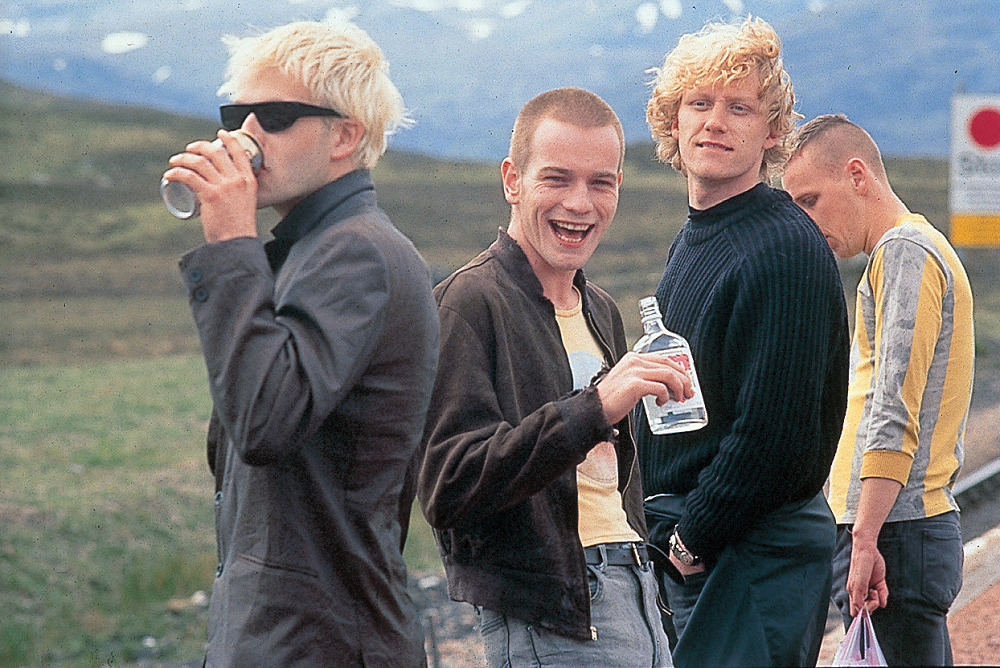
The film, for better or worse, dripped with an enticing coolness. Ewan McGregor’s Renton, Jonny Lee Miller’s Sick Boy and even Robert Carlyle’s Begbie were all intensely charismatic. Their performances channeled a James Dean-esque rebel archetype, creating a narrative allure that transcended the narrative’s dark underpinning.
Of course, this effect is only compounded by the soundtrack. Featuring titans of sexy rebellion – Lou Reed, Iggy Pop, Blur, Pulp, and Primal Scream – this further amplified this sensual seduction, granting the film an entrancing zip that functions as an invitation aboard a snarling dragon.
Where the book and film fundamentally diverge is in their approach to structured storytelling. As mandated by the nature of the medium, a film must maintain some semblance of a plot. A beginning, a middle and an end; some form of character arc and development; conflict and resolution; the heroic and the villainous. These are facets and features as old as theatre itself, without which films would collapse under their own weight.
In adapting the novel for the silver screen, John Hodge – Trainspotting’s screenwriter – faced a herculean task of narrative construction, revision and reinterpretation. Irvine Walsh’s original eschews conventional narrative for a mosaic of experience.
Rather than plot, it is composed of a series of vignettes: snapshots and tabloids, set pieces and silhouettes. Each chapter presents chronologically, but from varying first-person perspectives, recounting often unrelated to those before it.
Renton functions as the central mouthpiece, but many characters provide insights into the conscious streams of those who surround him. Crucially, Welsh subverts traditional narrative expectations. Renton is not the centerpiece of a heroic journey, but instead the central point in a rotating wheel, fundamentally absent of heroism or villainy. Instead, it is just a series of happenings, of events one after the other to which the experiencers cannot help but try to reason about from a moralising, sense-making standpoint.
Where the book rejects narrative, the film constructs it. Walsh isn’t telling a story. He is crafting a fifty-course banquet, with each dish giving the taster further insight into the worlds – internal and external, sociological and experiential – in which his characters live. Conversely, the film necessarily transforms this into a digestible narrative, congruent with cinematic storytelling norms.
Morally, this has a profoundly different effect. As humans constantly crafting narrative structures with which we make sense of our infinite experience, we inevitably sympathise with the narrative compulsion of others.
Films, in crafting such systemic plots, subconsciously encourage a sympathising with their characters. We like underdogs, and who is more of an underdog than a heroin-addled addict? Where the visual Trainspotting projects an aura of choice and action, its source material is a meditation on fate and inevitability.
Walsh’s novel, however, does not allow for this form of sympathy. In constantly chopping focal points and refusing to thread through his tapestry a central depiction of plot, the reader cultivates a different form of compassion. These people never chose these lives; they were allotted them, and so must they live them out. Choose Life is a mocking statement of the absurdity of alleged freewill: there is no choice at all.
The second great manifestation of difference is the tangible texture of each work.
In Trainspotting, the book, the characters ooze a pervasive sense of guttural baseness. While superficially charismatic to those they manipulate, Welsh ensures readers experience their true grotesque reality.
You can feel the grimness of each character. Their physical blights – shrunken veins, infected boils, and gratuitously vile bodily expulsions – become a source of instinctive repulsion, and a physical manifestation of their internal decay.
You can smell on the book’s pages the scent of stale urine, heated foil, overcooked heroin, and fetid fluids. You can sense the itchiness deep under their skin, and the nausea in the pits of their stomachs. Readers are compelled not to romanticise, but to feel profound compassion and distant horror.
The literary medium allows an unfiltered sensory immersion that cinema struggles to replicate. When reading, our minds fill in the gaps of sensation, invariably creating images more wretched than those in motion picture.
Books appear within us, as an apparition of us. Film and its consumption are an exercise of object perceiving subject, a boundary which is dissolved in literature.
Trainspotting, the film, is necessarily glossy. The lead actors are projections of desire and sexuality. Neither the greatest acting, nor the most skilful makeup design, can conjure a sense of horror and suffering requisite to truly suspend our inherent disbelief.
As touched on earlier, this is exacerbated by the charisma of each of the lead actors. Charisma is intoxicating; it pulls the wool over the rational parts of our brains. It taps into our primal need for connection, trust, and inspiration.
As a lens for understanding cultural narratives, charisma’s effect is exemplified in our perception of politics. Richard Neustadt, in his “Presidential Power and the Modern Presidents”, identified with compelling evidence that charisma is far more influential a factor than aptitude, morality, or proper experience.
Consider the American presidential elections of recent decades: Obama vs. Romney (2012), Trump vs. Clinton (2016), Biden vs. Trump (2024), Obama vs. McCain (2008), Bush vs. Gore (2000), Clinton vs. Dole (1996), Clinton vs. Bush (1992), and Bush vs. Kerry (2004).
With one notable exception – the 2020 Trump vs. Biden contest – I would argue that these elections were always won by the more charismatic candidate, providing a testament to the seductive power of personal magnetism over substantive rationality.
In Trainspotting, this charismatic effect becomes a critical lens for understanding audience perception. Where in actuality and in the book these characters are living lives of wretched suffering and condemnation, the film’s visual and performative charisma transforms their narrative into something else.
We cannot help but feel, when watching the film, that there is something enticing about their lives – a dangerous transmutation of moral perspective enabled by star power and cinematic presentation.
Rather than a sense of dejected depravity and pitiful immorality, Danny Boyle’s film’s visual and performative charisma transforms our interpretation into a feeling of adventure, defiance and delighted rejection of societal conformity.
When finished, each Trainspotting leaves a profoundly different taste on one’s tongue.
The film is salty, sharp, umami and refined. Forbidden and mysteriously sensual, it is like an oyster, a briny whisper promising more. The book, however, is acrid, and astringent, and gritty. Like chewing on aspirin, it is bitterly defiant against all things pleasant.
This is not a critique of superiority. Both are deeply informative, riotous fun, and marvellous expressors of myriad ideas and emotion. But in their distinct yet complementary approaches, they reveal the transformative power of narrative.
Ultimately, the result of Welsh and Boyle’s respective work is a mirror – fractured, brutal, and breathtakingly honest, yet textured with a different quality and sheen – through which we observe different facets of the chaotic complexity of human experience.

 The Eye of an Archer
Leave a comment