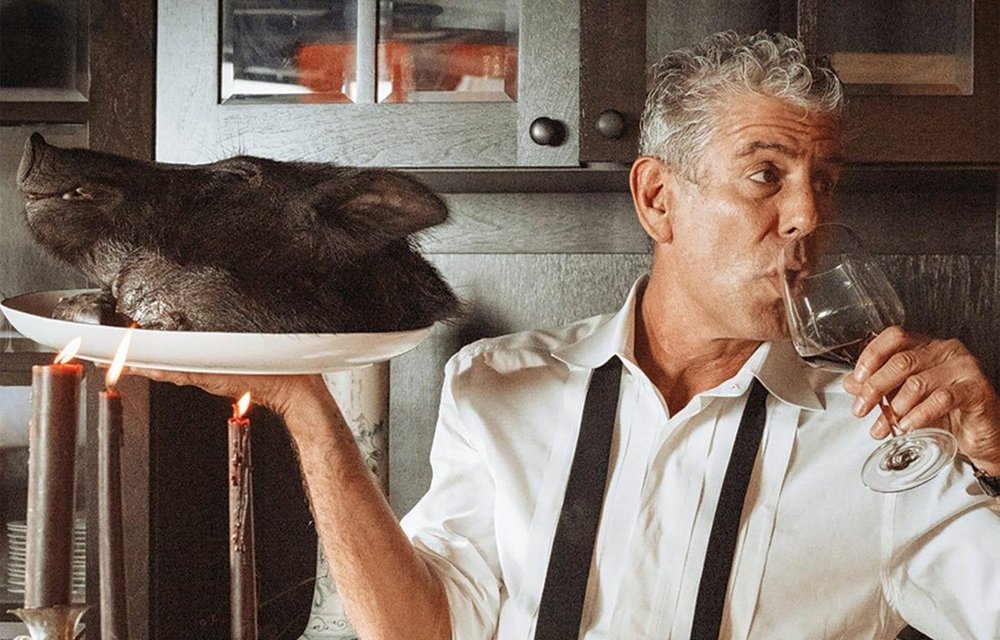
Anthony Bourdain remains a truly compelling figure. Kitchen Confidential chronicles his voyage through the tumultuous, bloody, murky, and electric waters of the culinary world—as well as human nature.
It is the story of an extraordinarily storied life: culinary school, bouts of addiction, working atop the Rockefeller, unfettered access to a New York that has long since vanished, Herculean substance use, countless restaurants, and characters so vivid they seem lifted from fiction.
Through the carefully focused lens of this book, human nature emerges as a slovenly servitude to carnal desire, an inalienable urge for intoxication, and a fixation on blood, grit, and passion. Testosterone, Bourdain would have us believe, is the driving force behind everything, and kitchens serve as the ultimate sanctuary for this über-masculine energy.
He is constantly smoking cigarettes, constantly talking about sex, constantly recounting tales of cocaine binges, heroin slumbers, and an interminable consumption of alcohol—yet never does he seem to truly delight in these pleasures. Food, however, is different. Food is pleasure incarnate, desire made tangible.
This book is a monument to food’s glory. Not food as a social function or symbol, but food as a pure sensory experience. Bourdain is a bone-crunching, blood-sucking, lip-smacking devotee of all things consumable. A lover of taste and texture, his greatest source of pride is his openness to eat anything and the gratification he derives from it.
So often, while reading, I was struck by the vividness with which he remembers specific meals, first tastes of food, and conversations had decades ago. The first time he ate oysters in France. The smell of butter at his grandmother’s house (“cheesy”). The dishes he cooked at every restaurant he worked in.
At least one hundred pages of this three-hundred-page book are spent extolling the magic of various foods and their infinite combinations. He genuinely loves the stuff, and it is infectious. The entire affair is as rich as a Châteaubriand. His love for food runs so deep that the reader can taste, smell, see, and gorge on the delights he describes.
But what makes this part-memoir, part gonzo-journalistic account of restaurants and food so compelling is its exploration of human nature.
He has clear ideas of what constitutes right practice and is generous in paying sincere tribute to all the people who influenced him. He writes with an honesty I admire deeply, a willingness to say things about people that may not be entirely flattering but, in doing so, creates portraits so real that one cannot help but find them endearing.
All of this is conveyed in a brash, swaggering prose—effortlessly readable and joyously expressive. He writes with such a distinct voice—deeply funny, rich, and as flavorful as the culinary delights he eulogizes.
I believe he was a good man, with good intentions and a good heart. But so much of the book is spent either alluding to or, more often, cataloging his immorality, selfishness, and his indulgence in every single one of the deadly sins.
He frequently reflects on how mean he could be in the kitchen—how ruthless and uncompromising. On how selfish he has been, how many relationships he has hurt and people he has damaged. I do not doubt the truthfulness of this.
But what I do doubt is the source of this behavior. He writes as if there is a part of his soul that relishes debauchery—as if the more immoral, the better. I do not believe that. Instead, he seems to me like someone who was deeply self-critical, unforgiving, and unkind to himself.
Only fleeting reference is made to his girlfriend, to his parents, to all the other things he loved in life. But when he does mention them—aside from his usual self-deprecation—he comes across as tender, compassionate, and entirely well-intentioned. His allusions to his privilege, and his sense of having squandered it, resonate with self-flagellation.
The kitchens he describes are not just kitchens. They are metaphors for his own mind—places of glorified dysfunction, paradox, and broiling passion. They are realms of sensual pleasures, of pure machismo and bravado, where conversation regularly revolves around the size of one’s penis.
The pages scream with an inexpressibly philosophical, hyperactive mind that did not know what to do with its roiling ocean of thought and emotion. Instead, he sought refuge in substances, in the simple thrill of the kitchen, and in working himself to the point of exhaustion in hot, dangerous, oppressive rooms.
But as the book nears its end, he ingeniously flips the script. After spending the first three-quarters on a boastful yet self-effacing rampage through the kitchens of New York and the entire spectrum of cuisine, the final chapters are gorgeously nuanced.
Dismantling his ego as a chef, then his belief that he has experienced all there is to experience, and finally his formerly amoral, nihilistic ethics, we are left with the picture of a man both beautiful and deeply complex.
“I have done everything – I have even killed a man,” said Dostoevsky’s Raskolnikov. Tragically, this is a statement that Bourdain could, in some ways, claim as his own. The character he casts himself as in Kitchen Confidential stands as a testament to his discipline, duty, hedonism, passion, charisma, and success.
So conflicted, so paradoxical, and yet so fully realized, Bourdain represents a sublime embodiment of humanness.

 The Eye of an Archer
Leave a comment