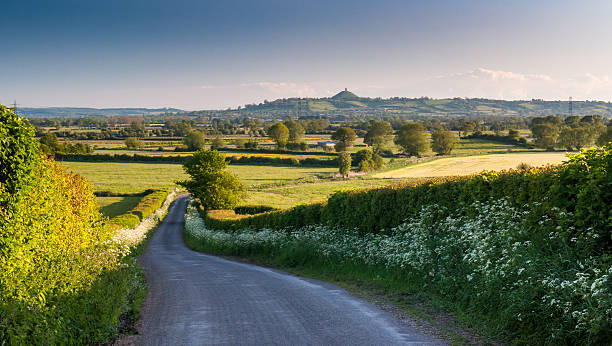
Up and over, a swinging right, a meandering left, then a squiggly weave. Like a ribbon caught in the wind, repeat that thirty-four times and you have a good idea of what it feels like to drive down 300 yards of English country roads.
Growing up, I spent many hours in the back of a car, being ferried to and from school, to friends’ houses, and back home again. Much of this was spent weaving around roads that, if viewed from above, would be akin to the scribbles of a child. These ancient roads form a capillary network, the smallest of all arteries, but just as essential and just as wondrous.
Like living walls, continuous hedgerows, older than many nations of the world, line the roads and billow with the life that teems inside them. Ancient oaks and sycamores peer over their tops, their branches reaching across the narrow lanes like curious fingers, as if inquiring about the identity of those disturbing their slumber.
As one flies around these roads at speeds that feel supersonic, you lose sense of where they’re taking you. Are you plunging into a magical woodland warren, or emerging into an unseen shire of more rolling green meadows? Invariably, they spit you out in just the place you want to be – towns with delightfully bookish names like Newdigate, Rusper, Haywards Heath, and Brockham.
“Why are these roads so windy and roundabout?” I often asked myself. The answer, I once read, is a tale just as storied as the roads themselves.
In days long past, way back yonder, farmers would herd their cattle through pasture and paddock. Cows and sheep, docile and wise as they are, would walk on ground that was dry and high. Herders would point them in a general direction, but the exact path could only be determined by these bovine beasts.
As time wore on and these paths were continually elected, they became worn, trodden, and established. Thus, when travel between towns became more commonplace, they formed the natural route for people to pass on. Then, when carts and cars came to be, they too opted for these naturally formed paths.
Now sealed in tarmac but still dancing their original curves, country lanes in the English countryside continue to count four-legged folk as their forebears. This thought only serves, every time I drive through the countryside, to deepen my sense of wonder at this quaint, historic, and beautiful land.

 The Eye of an Archer
Leave a comment