The cinema industry is, we are so often told, in decline. For years, the industry’s soothsayers and town criers have been foretelling the demise of traditional film attendance. The rise of streaming services and widespread digital piracy had already begun to reshape the landscape when the pandemic of 2020 provided what many feared would be an insurmountable blow.
The COVID-19 pandemic forced theatres worldwide to shutter their doors, while major studios postponed their blockbuster releases or pivoted to streaming platforms entirely. Yet contrary to dire predictions, according to research from Statista, in 2023 123.62 million cinema tickets were sold in the U.K., up from 117 million the year before. While the trends show a slow rise, numbers are still far below those seen pre-2020.
For the sake of myself, and for all that I deem valuable, I bloomin’ hope they are wrong.
To me, the cinema is a sacred place. To be swept up, for a two-hour period, in both escapist and aesthetic purity.
In meditation, a favourite teacher of mine often analogises conscious experience to being in a car. Depending on perspective, you can either feel like the world is rushing towards you, or that you are rushing past the world.
Such it is, for me, when watching films. One can flit between complete engrossment with the story, the characters, their feelings and their thoughts, or instead see the film as an artistic creation, an accumulation of sound design, editing, set building, acting, and direction.
Both perspectives are concurrently available, inseparable from one another, but capable of being interned separately. At once, we can abide in the plethoric magnitude of human experience, feeling as those in the worlds in front of us feel, whilst also marvelling at how on earth a group of people can be so genius, so artistic, as to channel their shared skills into one singular vision.
Film is now accessible in every corner of our lives. Our omnipresent phones can stream any film imaginable using our omnipresent mobile data. Whatever you like, whenever you like – the only caveat being, the screen you are watching it on is probably smaller than a piece of toast.
We have been tricked, fooled, into thinking this represents an amicable replacement for cinemas. It does not. So much of the magic of film lies not in just the art form itself, but in how one drinks it in. Were the Mona Lisa hung in the offices of a paper company in Pennsylvania, I doubt its effect would be quite as powerful.
A cathedral of silence, darkness, anonymity and immersion, the cinema remains one of the few places in our world that we can truly lose ourselves. Freed from distraction, ever-present communication, and demanding thoughts on which we always act, there is nothing quite like it.
No one is asking anything of you. Hell, you’re not even asking anything of yourself. It is a kind of freedom not found elsewhere.
Following my GCSEs (aka, the country-wide exams I took at 16), my parents gave me perhaps the greatest gift I ever received – a card which gave me unlimited access to the cinema in my local town. Over the coming year, I’m pretty sure I saw everything that came out. Often with friends and family, but more often by myself, I understand for the first time how beautiful going to the cinema alone is.
That unlimited access sparked a deeper love affair with cinema. Eventually, I was offered a job there and continued to have free, unlimited access to that hallowed place for many years that followed. Now, not working at a cinema, I no longer have those exact privileges, but I do have some that are not far removed.
The concept of unlimited cinema access has evolved significantly over the past few decades. The UK’s first major unlimited pass program, UGC Unlimited, launched in 2000. When UGC merged with Cineworld in 2005, the program evolved into Cineworld’s influential Unlimited pass scheme, which became a cornerstone of UK cinema membership models.
Other chains soon developed their own offerings. Odeon, which had historically relied on points-based loyalty schemes, launched their Limitless program in 2016. Premium chain Everyman introduced their Everywhere membership, while Vue opted for a different strategy, focusing on competitive single-ticket pricing.
Last week I reactivated my Odeon Limitless subscription, and have continually been bowled-over by the brilliance of the deal. For £20 a month, one gains unlimited access to whatever films they may be showing, in whichever venue across the country one chooses.
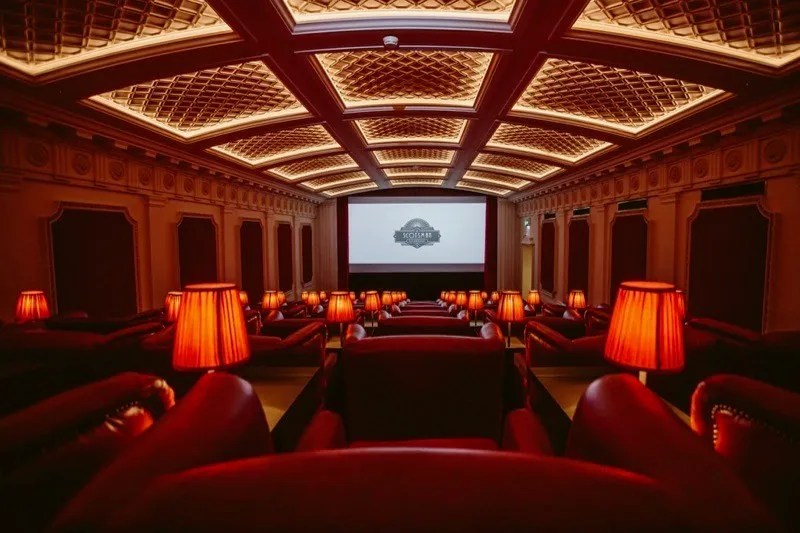
Today’s cinemas offer luxuries that would have seemed unimaginable just decades ago. Reclining leather seats rival those found in business class cabins, while state-of-the-art projection systems and immersive sound create experiences that even the most sophisticated home-cinema setup cannot match. Cinemas have continually evolved in the direction of the extraordinary, and yet remained surprisingly accessible.
At £20 a month – less than the cost of two standard tickets – my Odeon Limitless subscription feels almost too good to be true. It’s an invitation to experience every story, every world, every creative vision that finds its way to the silver screen. In an age where entertainment is increasingly fragmented and isolated, cinema remains one of the last bastions of shared cultural experience.
Perhaps that’s why I find myself returning, again and again, to those darkened rooms. It’s not just about the films themselves, though they are the foundation. It’s about preserving a space where stories still have the power to unite us, move us, and remind us of our shared humanity. In a world that seems to be constantly pulling us apart, that feels like something worth protecting.
Long Live Cinema, and Long Live Limitless.

 The Eye of an Archer
Leave a comment