Earlier this week, the world’s richest and most powerful unelected man, Elon Musk, tabled a $97.4 billion bid to take over the non-profit assets of OpenAI, the world’s most powerful AI organisation. Sam Altman, CEO of OpenAI, and a very powerful man himself, quickly rebuffed the offer, stating the company was not for sale.
Two billionaires, both hell-bent on developing AGI, both convinced that they are the species’ champion, and both convinced the other will bring the species’ end.
Many questions emerge. Why would he value the non-profit assets of a corporation at nearly $100 billion? Is his offer serious? And what is so special about this seemingly normal acquisition? Let’s break it down.
In 2015, a group of highly influential entrepreneurs and technologists foresaw the development of highly powerful AI having enormous consequences on human life. Keen to get it right, and desiring to build such technology in a way that was “beneficial for all of humanity”, they formed a non-profit organization that would develop advanced AI.
Chief among this group, were Elon Musk – of Tesla, SpaceX, Neuralink – and Sam Altman – the highly influential president of venture capital fund, Y Combinator. The organisation, OpenAI, was founded with an initial $50 million in donations To ensure the company was guided solely by safety, rather than profit-driven incentives, an initial $50 million in capital were invested.
In 2018 Elon Musk stepped down from the board, citing conflicts of interest with Tesla. In 2019, citing the necessity for incoming capital to fund research, OpenAI made a fundamental switch. They changed their model to a capped profit one, meaning original investors could receive 100x of their original investment, with their corporate governance structure having a non-profit branch (OpenAI Inc.) overseeing the for-profit operations (OpenAI LP).
The year 2019 also saw a $1 billion investment from Microsoft, a partnership which has deepened in recent years with further investment in 2021 and 2023 (the latter, featuring an additional $10 billion). Throughout, Sam Altman has framed this increasingly profit-based direction as solely necessary to benefit safe AGI, consistently reiterating that he held no equity in the company.
This reached a final head, in September 2024, when OpenAI announced their intentions to remove non-profit control, essentially becoming a fully-fledged for-profit corporation. Altman is set to receive equity in the company for the first time, which is soon set to be valued at around $300 billion. Nice.
It’s not hard to see Musk’s perspective. He invested money into a non-profit and has instead seen that charity turn into an inordinately powerful corporation, headed up by one of his co-founders. Musk, as he’s alleged in a huge ongoing court case, believes this amounts to shameless and egregious fraud. Legally allowing such would create horrific precedent and incentives. And Altman, in his eyes, is a lecherous, manipulative, untrustworthy scammer.
It’s not all that hard to see Altman’s perspective, either. As brilliant an entrepreneur as Musk is, he is also a giant dick. Forever trolling on Twitter, enraptured by his titanic ego, and wielding his ever-growing power to ever-more controversial effect, Altman likely sees him as entirely self-oriented. Add to this Musk’s own AI-related interests (he owns a lab called xAI, also seeking to develop AGI), and we can surmise that Altman does not take Musk’s challenges seriously.
So, is Musk’s $97.4 billion bid genuine, aimed at cause legal issues, or just further trolling? Well, the answer is probably all three. If it had been accepted, it would have represented huge expected value. OpenAI has some of the world’s leading AI models, and their assets represent huge power in what is arguably already the world’s most important industry. The Tesla founder would undoubtedly have been glad to acquire the company, for his personal interests, as well as for his visions of the world.
That said, the bid arguably primarily served to cause OpenAI a legal headache. In asking to acquire the non-profit assets, Musk may have placed Altman into a tricky situation. So convoluted is OpenAI’s corporate governance structure (much more on this over here), that extricating the non-profit operations would have proven troublesome.
Most likely, however, being Elon Musk, the bid was merely a $100-billion joke. There would be no way to acquire the non-profit branch, because there is no such thing. Whilst one wishes we could just chalk this off as churlish squabbling, we cannot. The stakes are far too high.
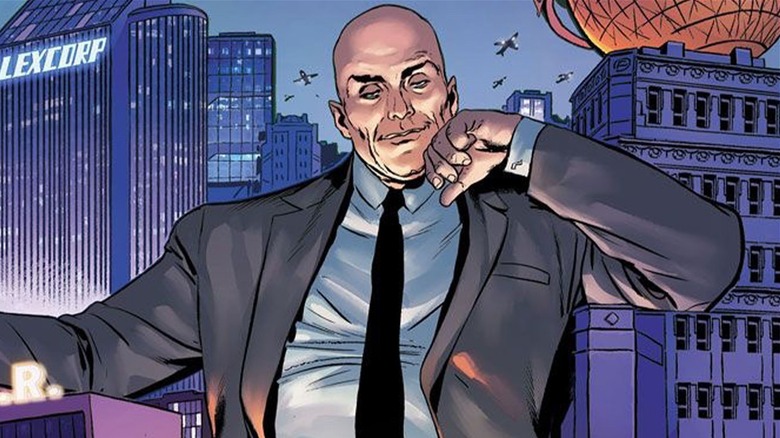
Tragically, comically, each actor casts the other as the villain in their play. The great irony to me, is that they both seem to be Lex Luthor. A “narcissist and egotistical mad scientist” who wishes to destroy Superman, “ostensibly because he views Superman as a threat to humanity, but in reality because he envies Superman’s popularity and influence”.
I cannot shake the feeling, acquired from intuition and the blurred lenses of media and public perception, that this may aptly describe both actors. Whilst they afront as being concerned with humanity’s interests, they are instead only concerned for empowerment and enrichment.
The great tragedy is that neither man seems to recognize their own reflection in the other. Like Luthor, both are brilliant minds who genuinely believe they’re protecting humanity, while pursuing paths that consolidate immense power in their own hands.
The difference is, that in their story, there is no obvious Superman, no obvious force for good. Just two would-be heroes, pursuing seemingly dangerous paths, each convinced that the other is a threat they must overcome.
Only time will tell who indeed has humanity’s greater interests at heart.

 The Eye of an Archer
Leave a comment