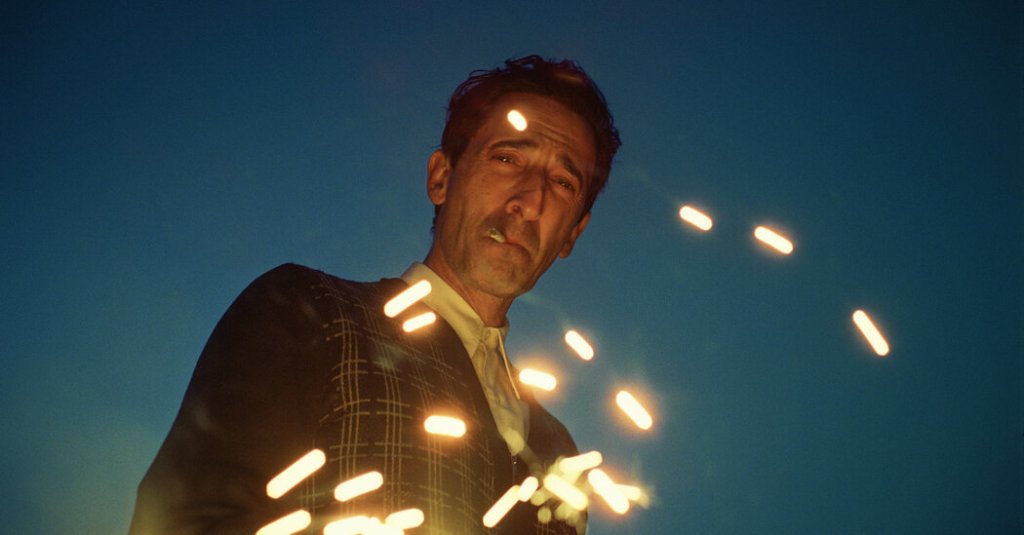
Brady Corbet’s The Brutalist traces thirty years in the life of László Toth, a Jewish-Hungarian architect who emerges from the Holocaust to forge a new life in America. While Toth’s architecture embraces brutalism, Corbet’s film stands as the aesthetic opposite to concrete.
Concrete is voluminous, formless, poured into predetermined shapes. As such, it is created from the outside in. The Brutalist, however, is carved from marble. Evoking a sense of inevitability, so expansive and rich this film is that I could not help but feel it has always existed. Having chipped away at a mountain of stone, Corbet reveals a form always waiting to be revealed.
The film is Homerian in its scope, sure to draw comparisons to cinema’s great epics: Apocalypse Now, 2001, Doctor Zhivago, The Godfather, There Will Be Blood. For me, though, it felt most like P.T. Anderson’s Phantom Thread. Both films share an obsessive precision, where the meticulous nature of their protagonists—Brody’s Toth and Day-Lewis’ Woodcock— is mirrored by their directors’ exacting vision. Each frame, each choice and each expression screams volumes about the collision of souls and the human experience.
It is perhaps the biggest film I’ve ever seen. Inexpressibly big, in its ideas, its emotions, its feelings and its sounds. Long, yes, clocking in at 215 minutes (with a 15-minute intermission), but its length has little to do with its big-ness. Big in a way that only motion picture can encapsulate, and yet, so much bigger than mere sound and image.
Holocaust, identity, culture, sex, addiction, wealth, art, relationships, language, status, power, beauty, compassion, work, Jewishness, nationality, religion, America. So much is said about each with nuance and precision. And yet, Corbet’s vision never creaks under the weight of its subject.
His direction is never rushed. It moves with a methodical calm and sits with a stoic stillness. The soundtrack is breathtaking too, conjuring both the raw power and deft subtlety of industrial creativity. Multiple sequences feature a gorgeous marriage of pensive still shots and the beats of grinding steel. The entire film is a magic trick, conjuring the illusion that it was crafted with consummate ease.
Architecture is often said to be the art of the articulation of space. Brutalism is said to command a sense of the sublime, the hardness of beauty, by which we are forced to look at ourselves. Like veins through marble, brutalist principles streak through the film’s core, articulating truths in a space that language alone cannot capture.
A towering, time-immemorial masterwork of brilliance.

 The Eye of an Archer
Leave a comment