
True to my pledge to do so every month, it is with great delight that I share with you my thoughts on the books I have read throughout July. I wholly enjoyed and admired the three books accounted for here, and would recommend them to pretty much anyone. They are prescient and inspiring and impressive and rather very good.
As always, I thank you sincerely for stopping by, and wish you a day filled with much beauty and joy.
…
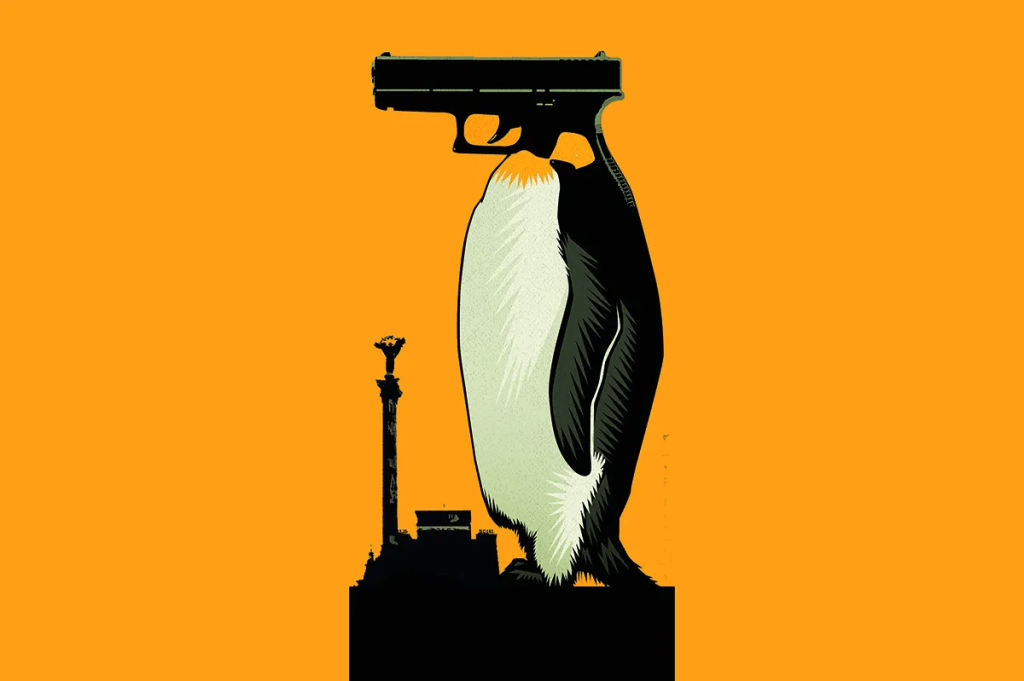
“Death and the Penguin“ (1996) Andrey Kurkov
Written in 1996 by Ukranian author Andrey Kurkov, this tragicomic tale of post-Soviet Kyiv conjures a world and an existence that one is very grateful not to occupy. It is a land of corruption, lies, ineptitude, collapse, death, and yet one that still finds so much humour and beauty within.
The book charts the jubilations and tribulations of Victor, a middling middle-aged writer, whose sole companion is a penguin, named Misha, whom he adopted from the city zoo after they could no longer afford to home the animals. Their lives are like their apartments which are like the city which is like the country: bleak, lonesome, cold, and depressing,
But after Victor accepts a new position as an obituary writer for a local newspaper, his life changes considerably. He soon comes to realise that his writing is not just serving to immortalise those passed on but is instead making him a pawn in an oligarchic zero-sum power grab. What follows is a very well-paced, impressively conceived, deeply empathetic, and somehow completely plausible story.
Kurkov succeeds in making even his most prototypically unlikeable characters a pleasure to spend time with, creating complex and deeply human humans. Still, Misha the Penguin, differentiated from another character, “Misha Non-Penguin, represents the greatest literary triumph. Through only his mannerisms, movements, and enduring silences, this animal communicates volumes about the world in which they live. He is a prism through which the misery of the collapsed state is refracted, splitting the happenings conjured into a vibrant spectrum of wit, cynicism, absurdity, and tragedy.
If my facial expression had been tracked during the time spent reading it, I imagine that a warmed, sullen perma-smile would have been observed throughout. Sharp, witty, amusing, compassionate, and written in uniquely styled prose, I very much enjoyed this novel, and I think you may too.
…

“The Ministry for the Future” (2020) Kim Stanley Robinson
How are we to address climate change? No nation alone can tackle this truly global issue, and a radical transition driven by unprecedented cooperation will be required to do so. The seemingly inconceivable nature of such a situation, however, often gives rise to feelings of dread, ineptitude, and powerlessness. And it is Robinson’s pragmatically hopeful thinking in the face of this that makes his fictionalised account of the coming few decades one of the most laudably optimistic books I have ever read.
Unifying both his extensive research and his wicked-smart imagination, Kim Stanley Robinson weaves a rich and complex tapestry of how the impending climate catastrophe may be addressed, with the threads of the seamster being the best science, politics, economics, and philosophy of our age.
Featuring more than 100 chapters across nearly 600 pages, the scope, breadth, and depth of this book is rather astounding. It is centred upon the endeavours of a fictionalised subsidiary body established by the Paris Agreement, dubbed ‘The Ministry for the Future’, who are tasked with securing the safety and well-being of future people. In painting the landscape of the coming centuries and what it demands of us, Robinson moves the novel fluidly and adeptly through varying locations, peoples, ideas, approaches and potential solutions.
The prose itself mirrors this globe-spanning exploration, constantly changing in both form and style. From first-person narrative accounts of country-devastating heatwaves to scientific authoritative tomes on geo-engineering projects to anthropomorphising riddle-like characterisations of ideas and constructs, the book itself feels like an analogy for the infinitely complex solutions required to tackle the problem at hand.
Carbon coins, rewilding programmes, geoengineering (solar radiation management and glacier draining), decarbonizing transportation, climate refugee policies, and altered agricultural practices, represent just some of the approaches explored. While this may sound dry or uninspiring, Robinson resoundingly succeeds in nonetheless writing a snappy, compelling, narrative-driven imagined happening of the coming decades.
That said, neither the author nor his message lands on the side of delusion. He and his central characters remain fearful that the actions of the Ministry will not provide meaningful change, and they maintain a clear-eyed perspective that this is not a problem that may never be truly “solved”.
But his optimism, grounded in the endurance of the human spirit, rings loud throughout. No stone is left unturned, and no nook nor cranny is left unchecked, in both the Ministry’s work to guarantee the safety of future people and in Robinson’s refutation of the idea that the challenges presented by climate change are insurmountable.
…

“Animal Farm” (1945) George Orwell
Death and the Penguin and Animal Farm provide a stunning double-billed refutation of the 20th century’s communist governments. Where the latter deploys a dry cock-eyed gaze to highlight how individual’s greed and their baseless lust for power undermined the Soviet Union, the former provides a chillingly unblinking glare at the worst of humanity.
Darker, more sinister, more methodical, and more brutal, George Orwell’s Animal Farm is a masterpiece in charting the transition of an ideology from one centred on equality for all, to one that instead became a vehicle for some of humanity’s greatest infliction of cruelty, suffering, and death. One derives the feeling whilst reading Orwell that not a word is wasted. The analogies are intentionally thinly veiled, the precision of Orwell’s gaze is laser-like, and every single sentence serves to illuminate the speed and ease through which malignant individuals can sow evil throughout the world.
I’m not sure how I have never read it before, but I firmly believe Animal Farm (as well as 1984) ought to have a place in every school curriculum in the Western world. I recall listening to a podcast featuring a woman who defected from North Korea, in which she described reading 1984 for the first time. She described how she was truly mind-blown at the pertinence and perceptiveness of Orwell’s portrayal of authoritarian regimes, not believing that he had not based his book on her home nation.
At a time when authoritarianism appears to be on the rise globally, and in which our leaders have utterly failed in sufficiently espousing and communicating the benefits and essentiality of liberal democracy, books like this are more important than ever. They remind us that we must remain vigilant in refuting attempts to undermine our freedom of speech, the equal protection of all people under the law, and the necessity of elections that are both free and fair.
Orwell reminds us that what we have is precarious and that it is damn well worth protecting. If you haven’t read any of his work before, then this is a pretty great time to make a start.

 The Eye of an Archer
Leave a comment